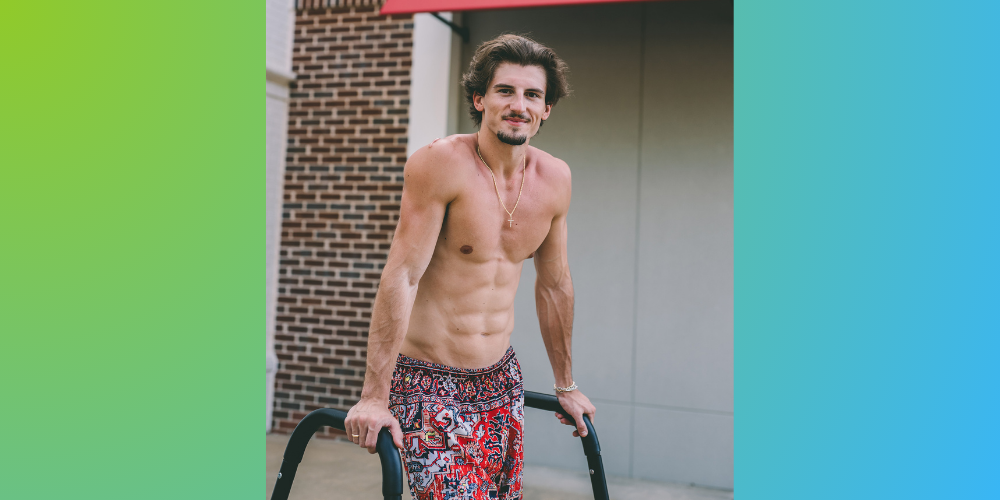
At just 23, Christian Culver has already lived through more fitness extremes than most face in a lifetime. His story isn’t about a single transformation, but a constant recalibration after chasing an image that nearly cost him his life.
Growing up in Arlington, Christian was always active, though never entirely by choice. His parents signed him up for karate, cross country, and football, which always felt like an obligation rather than a choice. After graduating from high school during the COVID years, Christian drifted into work at Memphis streetwear shop Bad Timing. Sneakers and style gave him something to focus on, but purpose was lacking. By late 2021, he began slipping into a cycle of weight gain, lethargy, and uncertainty. That’s when fitness found him. “I lost close to 30 pounds in six months,” he recalls. “It wasn’t just about working out, but discovering how nutrition and training actually worked for me. I transformed into someone I had never even met before,” Christian remembers.
But what began as empowerment soon spiraled into obsession. Inspired by the rise of TikTok fitness stars, Culver pushed himself harder and harder. He logged over 750 consecutive days at the gym, sometimes training up to eight hours daily with cardio, weights, and sauna sessions. His body fat dropped to an alarming 3.3 percent. Through his fitness Instagram persona, he looked unstoppable. Internally, he was breaking down, and did not even realize it.
In late 2022, while in the throes of his exercise addiction, Christian consulted with his doctor for blood work, which confirmed the worst: his liver and kidneys were failing, his testosterone had plummeted, and his nervous system was under extreme stress. “I was literally dying, and I had no idea,” he says. “I had to ask myself, do I keep chasing clout online, or do I take a step back and save my life?”
That turning point became, in his words, a “canon event.” He regained weight, focused on recovery, and began untangling his identity from online validation. However, stepping away left him with questions. Who was he outside of fitness? What did it mean to be “Christian,” not just a fitness persona people idolized on Instagram?
For a time, he worked in restaurants, partied, and tried to fit into a different mold. But the pendulum swung again, this time toward something steadier. Now, three years after his troubling diagnoses, Christian’s bloodwork is healthy, his hormones have begun to normalize, and his outlook on health and fitness is more grounded.
“Today, I’m the healthiest and clearest I’ve ever been,” he says. “I’m focused on being the best and healthiest version of me.”
That version is disciplined and still striving for athletic goals, but much more balanced. Now, Christian runs 40–50 miles weekly and strength-trains daily, but with moderation and self-awareness rather than obsession. He still shares his journey online (@gettyfit), this time not to impress, but to be honest about the highs and lows of fitness culture.
“Social media only shows you the good parts,” he says. “But nobody knows my body like I do. Now I’m finally listening.”
By Zoe Harrison
Photo by Tindall Stephens