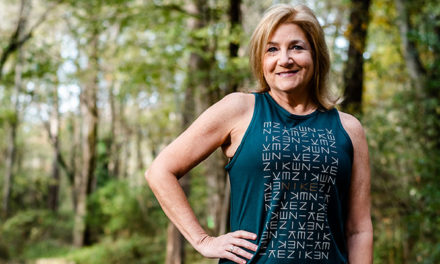

Jennifer Sims, 59, an educator, was diagnosed with breast cancer in May.
A routine mammogram led to a diagnostic mammogram and ultrasound, which showed abnormal results. Sims was told she needed a biopsy out of precaution.
Sims went to the biopsy alone, not worried or thinking much of it until the nurse explained what the results could mean.
“She told me to look for the word ‘malignant,’ meaning I have cancer, or ‘benign,’ meaning I don’t,” Sims recalls. “At this point, I started to get a little anxious, but I have a strong belief in God.”
Leaning into her faith, Sims reached out to her prayer community for support. She started declaring to herself and her loved ones that she was a breast cancer survivor before she even received her diagnosis.
“I just started speaking that I’m a survivor,” Sims says. “I didn’t know what it was or what I had, but I knew that I was going to be okay.”
The biopsy showed that Sims had Ductal Carcinoma In Situ (DCIS) — a cancer that starts in a milk duct and has not grown into the rest of the breast tissue. Sims was grateful to learn that DCIS is non-invasive and non-life-threatening. The doctor called it a “stage-zero” cancer.
“I was overjoyed,” Sims says. “I didn’t even know there were different types of breast cancer. Maybe if I did, I wouldn’t have prayed as hard.”
DCIS is a non-invasive breast cancer, meaning the abnormal cells are li
x online in the best USA pharmacy https://bornintegrativemedicine.com/wp-content/uploads/2026/04/jpg/purchase-nolvadex.html no prescription with fast delivery drugstore
mited to that area and don’t spread to other parts of the body. However, if left untreated, there is a risk of the cancer becoming invasive over time.
Sims followed her recommended treatment plan: a lumpectomy — or surgical removal of the cancerous cells — and five precautionary radiation treatments. Today, she is cancer-free.
“I never thought that I would be diagnosed with any kind of cancer,” she says. “When you hear the word cancer, you get scared, but everything ended up working in my favor.”
After catching her cancer in a very early stage, Sims says she can’t stress the importance of getting routine mammograms enough. She now hosts a podcast called Faith Over Fear Ministries, where she engages in conversations that raise awareness about breast cancer and the importance of routine screenings.
“Women have these myths about mammograms,” Sims says. “I don’t know where they’re coming from. They make up their minds that they’re scared and not going to do it. Instead, they should be scared of what they don’t know because what they do know can save their life.”
The American Cancer Society recommends that women aged 45 to 54 should have yearly mammograms. For those 55 and older, women can continue with annual screening or switch to screening every other year. Women at high risk, such as those with a family history of breast cancer, certain genetic mutations, or prior chest radiation, should start annual screening at age 30.
Visit Cancer.org/cancer/types/breast-cancer to learn more.