
For Dr. Carrie Patterson, caring for women’s health is both personal and professional. A native Memphian, she grew up around medicine (her mother worked at the University of Tennessee in Graduate Medical Education) and was exposed to physicians from an early age. That early exposure eventually led her to attend medical school at UT Health Sciences in Memphis and find her calling in Radiology, specializing in Mammography.
Her choice to enter this field was also shaped by personal experience. Her grandmother died of late-diagnosed metastatic breast cancer, giving Dr. Patterson an especially meaningful perspective on the importance of early detection. She was also inspired to work both with and for women, saying, “I think working with women who want to take care of other women is very empowering.”
As a breast radiologist, Dr. Patterson does far more than read mammograms. Her training encompasses breast imaging and intervention, including biopsies and procedures. She also sits down with patients to deliver their mammogram results, sometimes sharing happy news, and sometimes helping women navigate a difficult diagnosis.
She frequently hears women express anxiety about mammograms, whether they will hurt or if radiation is dangerous. She encourages women not to let fear stand between them and potentially lifesaving information. During a mammogram, the amount of radiation involved is very small, and the exam itself is brief. It may be briefly uncomfortable, she says, but it shouldn’t be painful. “If you can find something early, your treatment options are so much better,” Dr. Patterson says.
Dr. Patterson practices at Diagnostic Imaging (DI), part of Memphis Radiological, where she appreciates the quality of the technology and care. DI offers 3D mammography along with other breast imaging services. Dr. Patterson says the technology continues to evolve, including the recent addition of artificial intelligence tools at DI that can assist radiologists in interpreting images. “There’s always something new coming,” she says. “We are actively working towards adding contrast-enhanced mammography to the list of services we offer at DI. Contrast-enhanced mammography is a test that combines your mammogram with the administration of IV contrast through a vein in your arm to not only see the anatomy of the breast, but also get information about how the tissue is functioning, not just what it looks like.”
For young women who aren’t yet having routine mammograms, Dr. Patterson encourages them to pay attention to changes in their breasts. A new lump, pain or tenderness, nipple discharge, swelling, redness, or anything that feels different should be discussed with a physician. Other aspects like family history, breast density, genetics, and risk factors can also affect screening recommendations.
Dr. Patterson encourages women to talk with their primary care physician or OB-GYN about their individual risk. “We calculate lifetime risk and five-year risk of developing breast cancer for everyone getting a mammogram and use updated history to keep the calculation accurate each year. In the meantime, we make it a priority to obtain your prior imaging for comparison, so we can review your history and watch for subtle changes over time.”
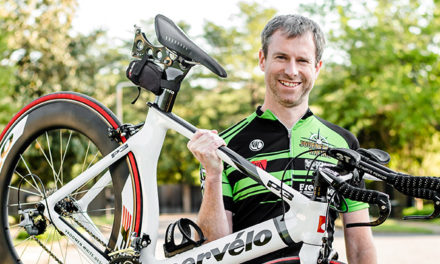
Dr. Patterson practices the healthy lifestyle she encourages in her patients. A lifelong runner, she also enjoys swimming and Pure Barre, but she always comes back to running. “The best exercise for you is the one you enjoy,” she says. She has qualified for and completed the Boston Marathon twice, the Chicago Marathon, and most recently the Berlin Marathon this September, her third of the six World Marathon Majors. She hopes to eventually complete all six, with New York, London, and Tokyo still on her list. Running a half marathon in all 50 states is another goal she is pursuing.
There’s also a natural connection between Dr. Patterson’s approach to medicine and her approach to marathon running: both require preparation, perseverance, and the ability to stay calm when things get difficult. As a physician, she helps women move past the fear of the unknown by giving them information and a clear path forward; as a runner, she’s learned to do the same: focus on the current mile she’s in, trust her training, and keep moving forward.
For women who may feel intimidated to get their screening, she says, “Most of the time, the outcome is not as big as the fear. Knowledge is power, and it’s better to know as early as possible.”
Five Things Every Woman Should Know About Mammograms
Screening starts at 40 for many average-risk women.
Current American College of Radiology (ACR) guidance says women should begin annual mammograms at age 40. This should continue every year, without an upper age limit, as long as the person is in good health.
Some women need to start earlier.
A strong family history of breast cancer, certain genetic mutations, previous breast conditions, or other risk factors may mean earlier or additional screening is appropriate. Women should have a formal breast cancer risk assessment by age 25 to identify any higher-than-average risk factors that could influence earlier or supplemental screening. Talk with your doctor about your personal risk.
3D mammography gives doctors more information.
3D mammography takes multiple images of the breast from different angles, creating a more detailed view than a standard 2D mammogram. Diagnostic Imaging offers 3D mammography and AI-assisted interpretation as part of its breast imaging services. AI acts as a second set of eyes to increase the cancer detection rate of tiny, subtle tumors or calcifications, and can look past dense tissue to find hidden abnormalities.
Don’t wait for your next mammogram if something feels wrong.
A new lump, nipple discharge, swelling, redness, pain, or another unexplained breast change should be evaluated, even if your most recent mammogram was normal. Screening and diagnostic imaging serve different purposes.
Don’t let fear keep you from getting screened.
A mammogram is quick and uses a very small amount of radiation. It may be uncomfortable, but it shouldn’t be painful. The goal is to detect breast cancer as early as possible, when treatment options are often more favorable.
Dr. Patterson’s advice: Be proactive, know your body, and talk with your doctor about the screening plan that’s right for you.
By Zoe Harrison
Photo by Tindall Stephens