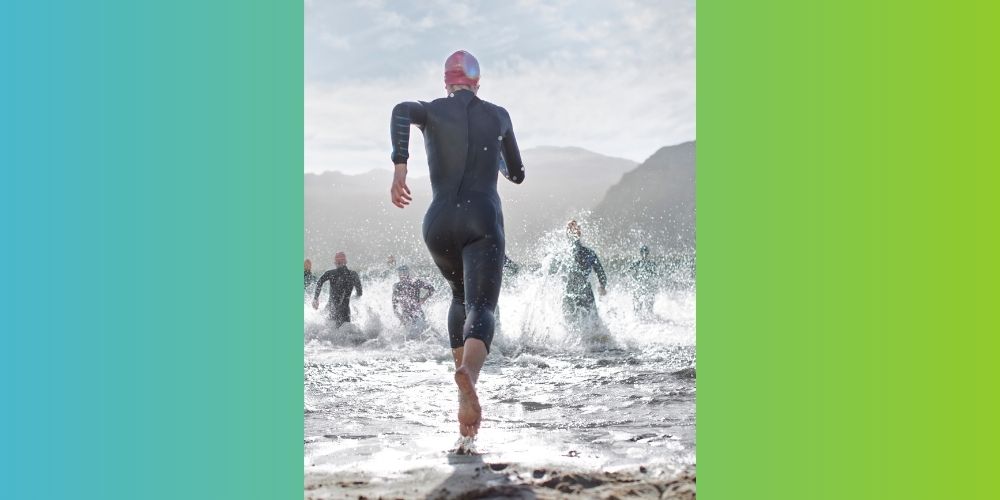
For many triathletes, especially first-timers, the swim isn’t just the hardest part of the race; it’s the most intimidating. It’s not really the distance or even the fitness part. It’s just being in the open water. No black line to follow. Low to no visibility much of the time. No walls to touch every so often. Add in a crowd of arms and legs, waves, chop, maybe an ill-fitting wetsuit, and it’s easy to see why anxiety spikes before the horn even goes off. But here’s the truth: open water fear is normal. Everyone, even the pros at times, experiences it. It’s a mix of nerves and the unknown, but your comfort in the open water is totally trainable. So let’s dive into some practical tips to help build your confidence before your next event.
PRACTICE IN A CONTROLLED ENVIRONMENT
The fastest way to get comfortable in open water is to remove the chaos while keeping the environment. That’s why controlled open water sessions are so valuable. You get the feel of swimming without walls, the ability to practice open water skills, and the safety of having eyes on you. If you have a place to swim, have a friend follow you in a kayak. Or stay close to a dock or shoreline and use a personal flotation buoy trailing behind you. They are super cheap and an extra layer of safety. Locally, we have organized open water swim sessions at Shelby Farms Park specifically for this reason. We even have a super short 50m course where you can always put your feet down. There are also certified lifeguards in the water. It’s one of the only programs like it in the country, and we are proud to have helped start it six years ago. If you have not been, I highly recommend it. It has helped so many people improve their open water swimming. Just search for Shelby Farms Open Water Swimming.
START SHORT AND BUILD UP
Most people make the mistake of trying to replicate race distance too soon. That’s not the goal early on. Even experienced triathletes can be heard at the start line saying, “That looks a lot farther than last time.” I’ve said it! Your first few sessions might be only two to three minutes of continuous swimming at a time. The objective is to stay relaxed, not to swim far. As that comfort builds, distance naturally follows. Think of it like a road runner jumping on the trails for the first time. The dynamics are different. No one expects perfect form and pacing on technical terrain right away. Open water works the same way. Getting the feel for the water takes some time.
CONTROL YOUR BREATHING BEFORE YOUR PACE
This should probably be number one if we are ranking these tips. When athletes panic in open water, it’s almost always a breathing issue, not a fitness issue. If your breathing gets rushed, everything falls apart. Stroke timing gets off, body position falls apart, and perceived effort level skyrockets. All from your breathing rhythm. Before you think about speed, focus on long, controlled exhales in the water. Breathe out of your nose and mouth, and then in through your mouth as you turn your head. If you need to flip onto your back or breaststroke to reset, do it. Get your heart rate down and your breathing back to baseline. If your breathing is controlled, your effort will feel in line.
LEARN TO SIGHT WITHOUT DISRUPTING YOUR STROKE
In the pool, you follow a line; in open water, you follow buoys you can barely see and people who also may not be swimming straight. That’s where sighting comes in, lifting your eyes forward just enough to see your next buoy. The mistake most athletes make is bringing their head way out of the water every time they sight, which drops the hips and feet, and decelerates you. It makes your life harder having to get back up to speed by the time you want to sight again. Woof. So work on lifting your eyes out of the water just enough to see; we call it alligator eyes. Wait to inhale until after you have turned your head, not while looking forward. Lift. Look. Breath. One extra tip is to pause the arm that is reaching forward just a hair longer on a sight so that you have a little more time to look, turn your head, and inhale. So really it’s lift, look, and breeeeeeeaaaaattthhhhheeeee.
GET COMFORTABLE BEING UNCOMFORTABLE
Open water will never feel exactly like the pool, and that’s okay. There will always be moments where things feel off or disrupt your flow. You’ll get hit by other athletes. You might hit a buoy. Say hello to a fish. You might breathe straight into a wave and take in some water. You might get water in your goggles. The goal isn’t to eliminate discomfort; it’s to recognize that you’re still in control when it shows up. Our most successful open water swimmers do it a lot. With people. In a lot of different conditions. The athletes who succeed aren’t the ones who avoid stress; they’re the ones who have experienced it enough times that it no longer bothers them. Don’t panic, reset, and get back to it.
Dale Sanford is the co-founder of BPC Performance, Inc. and has been coaching individuals and athletes all over the world since 2009. You can catch up with Dale @bpcperformance on IG, or listen to the Coaches on Couches Podcast. If you’d like to start your health or sports performance journey with BPC, visit Buildpeakcompete.com
By Dale Sanford, Performance Coach